
Valuable_insights_regarding_vegasheros-uk_uk_and_UK_property_investment_opportun
- Valuable insights regarding vegasheros-uk.uk and UK property investment opportunities
- Analyzing Digital Trends and Market Volatility
- The Role of Data in Decision Making
- Strategic Approaches to Property Acquisition
- Diversification of Asset Classes
- Navigating Regulatory Frameworks and Compliance
- Steps for Ensuring Operational Compliance
- The Intersection of Technology and Real Estate
- Future Outlook for Integrated Markets
Valuable insights regarding vegasheros-uk.uk and UK property investment opportunities
Navigating the complexities of the modern digital landscape requires a keen eye for detail and a strategic approach to resource allocation. Many individuals looking for stability and growth find themselves analyzing platforms like vegasheros-uk.uk to understand the shifting trends within the online ecosystem. The intersection of digital engagement and tangible asset management creates a unique environment where information is the most valuable currency available to the disciplined observer. Understanding how these digital touchpoints interact with broader economic shifts is essential for anyone attempting to build a resilient financial or professional foundation in the current climate.
The United Kingdom has long been a focal point for diverse investment strategies, ranging from traditional brick-and-mortar real estate to the burgeoning digital economy. As the landscape evolves, the ability to discern between fleeting trends and sustainable opportunities becomes a critical skill set for participants in the market. Investors and enthusiasts alike must look beyond the surface level of a website or a platform to comprehend the underlying mechanisms driving value. This article explores the multifaceted relationship between digital information sources and the broader opportunities present in the British property and technology sectors.
Analyzing Digital Trends and Market Volatility
The rapid pace of technological change means that what is considered cutting-edge today may become obsolete by the following year. Digital platforms often serve as the first indicators of shifting consumer behaviors and capital flows. When looking at resources such as vegasheros-uk.uk, one can observe how specific niches gain traction before they hit the mainstream consciousness. This early adoption phase is where the most significant advantages are found for those who possess the analytical tools to interpret the data correctly. It is not merely about seeing what is popular, but understanding why it is gaining momentum in specific demographic segments.
Market volatility is a constant factor in both the digital and physical worlds. In the digital realm, volatility manifests as rapid changes in user engagement and platform relevance. In the property sector, it appears as fluctuations in interest rates and housing demand. Bridging the gap between these two worlds requires a holistic view of how digital connectivity influences physical movement and spending. A person who understands that a surge in online activity often precedes a shift in local economic strength is better positioned to make informed decisions regarding long-term assets.
The Role of Data in Decision Making
Data serves as the backbone of modern strategic planning. Whether one is evaluating a new online service or a residential development in Manchester, the quality of the underlying information determines the success of the endeavor. High-quality data provides a roadmap through the fog of market uncertainty, allowing for more precise forecasting and risk mitigation. Without robust data, even the most experienced professionals are essentially operating on intuition, which is a dangerous strategy in high-stakes environments. The integration of real-time digital metrics with traditional economic indicators is becoming the gold standard for modern analysts.
Furthermore, the democratization of information through the internet has changed the power dynamics of the marketplace. Previously, specialized knowledge was held by a small elite, but now, platforms provide a gateway for a much broader audience to participate. This shift requires a new type of literacy, one that focuses on the ability to filter noise from signal. As more people gain access to tools and insights via sites like vegasheros-uk.uk, the competition for quality opportunities increases, making the ability to synthesize complex information even more vital.
| Interest Rates | Transaction Volume | Direct influence on borrowing power |
| Population Growth | User Acquisition Rate | Determines future demand levels |
| Consumer Confidence | Engagement Metrics | Predicts short-term spending shifts |
| Infrastructure Quality | Platform Latency | Affects the reliability of operations |
The relationship between these indicators is often non-linear and deeply interconnected. For example, a spike in digital engagement in a specific geographic region might signal an influx of young professionals, which in turn drives the demand for rental properties in that area. Recognizing these patterns allows for a proactive rather than reactive approach to wealth management and business development. The goal is to identify the subtle signals that precede large-scale market shifts.
Strategic Approaches to Property Acquisition
Property investment in the United Kingdom remains one of the most established methods for long-term wealth preservation. However, the approach to acquiring property has changed significantly due to the availability of granular data and the rise of remote management tools. Investors no longer need to be physically present in a city to identify lucrative opportunities. Instead, they can leverage digital intelligence to assess neighborhood trends, school catchment areas, and planned infrastructure projects from anywhere in the world. This connectivity has opened up the UK market to a global pool of capital.
Successful acquisition strategies often involve a mix of high-yield rental properties and capital appreciation plays. The former focuses on consistent cash flow, often through student housing or professional lets, while the latter focuses on buying in emerging areas that are expected to see significant growth. Both strategies require a deep understanding of local dynamics and a willingness to adapt to changing regulations. The ability to pivot between these strategies based on economic signals is what separates professional investors from casual participants.
Diversification of Asset Classes
Diversification is the cornerstone of risk management. While property is a tangible and relatively stable asset, it is not immune to economic downturns or changes in tax legislation. Therefore, a well-rounded portfolio often includes a mix of different property types and locations. Some investors might focus on commercial real estate, which offers different risk profiles and return structures compared to residential housing. Others might look into REITs (Real Estate Investment Trusts) as a way to gain exposure to the property market without the complexities of direct ownership.
Integrating digital insights into this diversification process is essential. By monitoring the digital footprint of different sectors, an investor can gauge which areas of the property market are being overlooked or overhyped. For instance, if digital activity suggests a rise in remote work trends, an investor might shift focus from city-center apartments to larger suburban homes with dedicated office spaces. This level of agility is only possible through the continuous monitoring of various information streams, including specialized platforms and economic reports.
- Identification of high-growth urban regeneration zones.
- Assessment of local rental demand through demographic data.
- Evaluation of transport links and future connectivity projects.
- Monitoring of local legislative changes regarding tenant rights.
- Analysis of historical price trends in specific postcodes.
The use of such lists helps in maintaining a disciplined approach to vetting potential acquisitions. Without a standardized method for evaluating opportunities, it is easy to fall victim to emotional decision-making or to be swayed by superficial market hype. A systematic approach ensures that every potential investment is measured against the same rigorous criteria, providing a level of objectivity that is crucial for long-term success.
Navigating Regulatory Frameworks and Compliance
One of the most daunting aspects of any significant financial undertaking is the maze of regulations that govern it. In the UK, property investment is subject to a wide range of laws, from planning permissions and building codes to tax obligations and landlord-tenant legislation. Similarly, the digital sector is facing increasing scrutiny regarding data privacy, consumer protection, and platform accountability. Navigating these waters requires not only legal knowledge but also a proactive stance on compliance to avoid costly mistakes and reputational damage.
For those engaging with digital platforms or using them to inform their physical investments, staying updated on regulatory shifts is a full-time job. Changes in capital gains tax, for example, can fundamentally alter the profitability of a property portfolio overnight. Likewise, new digital privacy laws can change how data is collected and utilized for market research. The most successful entities are those that view compliance not as a hurdle to be cleared, but as a framework within which to operate safely and sustainably.
Steps for Ensuring Operational Compliance
Maintaining compliance requires a structured and repeatable process. It is not a one-time event but a continuous cycle of monitoring, assessment, and adjustment. Establishing a robust internal framework helps to ensure that all activities remain within the boundaries of the law, even as those boundaries shift. This is particularly important when dealing with cross-border transactions or when using international digital tools to manage domestic assets.
- Conduct regular audits of current operational procedures and documentation.
- Engage with legal and financial experts to interpret new legislation.
- Implement automated systems to track compliance deadlines and requirements.
- Provide ongoing training for all staff members involved in decision-making.
- Establish a contingency plan for rapid adaptation to regulatory changes.
By following a structured approach, organizations and individual investors can minimize the risk of non-compliance. The cost of prevention is almost always lower than the cost of remediation, whether that be through fines, legal fees, or the loss of operating licenses. A culture of compliance builds trust with stakeholders, including lenders, tenants, and regulatory bodies, which is an invaluable asset in any competitive market.
The Intersection of Technology and Real Estate
PropTech, or property technology, is revolutionizing the way real estate is bought, sold, and managed. From blockchain-based title transfers to AI-driven valuation models, the tools available to the modern investor are more powerful than ever. This technological wave is not just about making processes faster; it is about making them more transparent and accessible. For example, virtual reality tours allow potential buyers to inspect properties from across the globe, significantly reducing the friction in international transactions.
The rise of big data has also allowed for much more sophisticated risk assessment. Instead of relying on outdated census data, investors can now look at real-time movement patterns, spending habits, and even social media sentiment to predict the future of a neighborhood. This level of insight was previously reserved for institutional giants, but it is now becoming available to a much wider audience. As more people utilize digital hubs like vegasheros-uk.uk to gather intelligence, the speed of the market will likely increase, rewarding those who can act quickly on accurate information.
However, this technological surge also introduces new risks. Cybersecurity has become a primary concern for anyone managing high-value assets digitally. The potential for data breaches or fraudulent transactions is a constant threat that requires sophisticated defense mechanisms. As the physical and digital worlds become increasingly intertwined, the security of one will inevitably depend on the security of the other. Investing in robust digital infrastructure is no longer optional; it is a fundamental requirement for any serious participant in the modern economy.
Looking toward the future, the integration of the Internet of Things (IoT) into residential and commercial properties will create even more data points. Smart homes will not only offer convenience but will also provide detailed information on energy usage, occupancy patterns, and even structural health. This data will become a new form of value, potentially influencing property prices and insurance premiums. The ability to harness and interpret this stream of information will be a key differentiator for the next generation of property owners and managers.
Future Outlook for Integrated Markets
The convergence of digital intelligence and physical asset management is set to accelerate. We are moving toward an era where the distinction between a digital asset and a physical one becomes increasingly blurred. For instance, a digital token representing fractional ownership of a building is both a piece of software and a claim to a physical structure. This hybridity will require new legal frameworks and new ways of thinking about ownership and liquidity. Those who can navigate this hybrid reality will find themselves at the forefront of the next economic evolution.
As we look at the trajectory of the UK market, the emphasis will likely shift toward sustainability and technological integration. Green building certifications and energy-efficient technologies are becoming mandatory requirements rather than optional extras. Simultaneously, the ability to manage these assets through seamless digital interfaces will become the standard. The investors who succeed will be those who can marry the stability of traditional property with the agility and insight provided by the digital age, maintaining a constant vigil over the shifting tides of information.
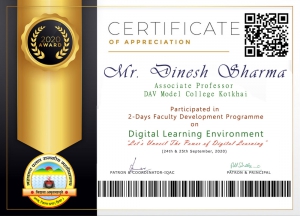 Participant Detail Mr. Dinesh Sharma Associate Professor DAV Model College Kotkhai Session Details Participant present in all the sessions on 24th & 25th September, 2020. Barcode ID Mr. Dinesh SharmaMPGCAMBfdp2020p01
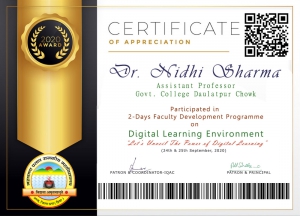 Participant Detail Dr. Nidhi Sharma Assistant Professor Govt. College Daulatpur Chowk Session Details Participant present in all the sessions on 24th & 25th September, 2020. Barcode ID Dr. Nidhi SharmaMPGCAMBfdp2020p02
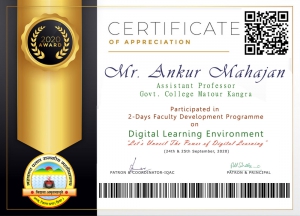 Participant Detail Mr. Ankur Mahajan Assistant Professor Govt. College Matour Kangra Session Details Participant present in all the sessions on 24th & 25th September, 2020. Barcode ID Mr. Ankur MahajannMPGCAMBnfdp2020p03
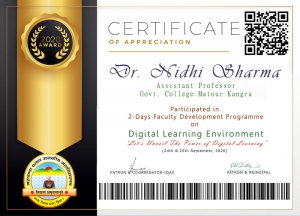 Participant Detail Dr. Nidhi Sharma Assistant Professor Govt. College Matour Kangra Session Details Participant present in all the sessions on 24th & 25th September, 2020. Barcode ID Dr. Nidhi SharmaMPGCAMBfdp2020p04
 Participant Detail Dr. R. K. Kaundal Associate Professor Govt. Degree College Matour Session Details Participant present in all the sessions on 24th & 25th September, 2020. Barcode ID Dr. R. K. KaundalMPGCAMBfdp2020p05
 Participant Detail Dr. Joginder Singh Dulta Associate Professor DAV Centenary College Kotkhai (Shimla) Session Details Participant present in last 2 sessions on 25th September, 2020. Barcode ID Dr. Joginder Singh DultaMPGCAMBfdp2020p06
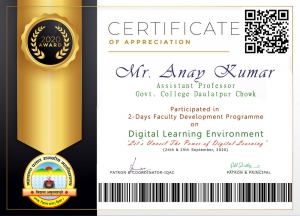 Participant Detail Dr. Nidhi Sharma Assistant Professor Govt. College Matour Kangra Session Details Participant present in all the sessions on 24th & 25th September, 2020. Barcode ID Dr. Nidhi SharmaMPGCAMBfdp2020p04
 Participant Detail Dr. Nidhi Sharma Assistant Professor Govt. College Matour Kangra Session Details Participant present in all the sessions on 24th & 25th September, 2020. Barcode ID Dr. Nidhi SharmaMPGCAMBfdp2020p04
 Participant Detail Ms. Sonia Rathour Assistant Professor Govt. College Jukhala, Bilaspur Session Details Participant present in all the sessions on 24th & 25th September, 2020. Barcode ID Ms. Sonia RathourMPGCAMBfdp2020p10
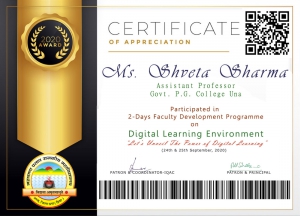 Participant Detail Ms. Shveta Sharma Assistant Professor Govt. P.G. College Una Session Details Participant present in all the sessions on 24th & 25th September, 2020. Barcode ID Ms. Shveta SharmaMPGCAMBfdp2020p11
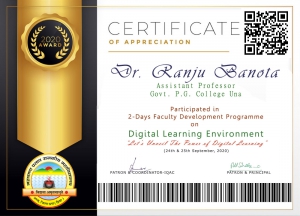 Participant Detail Dr. Ranju Banota Assistant Professor Govt. P.G. College Una Session Details Participant present in all the sessions on 24th & 25th September, 2020. Barcode ID Dr. Ranju BanotaMPGCAMBfdp2020p12
 Participant Detail Ms. Anu Lakhanpal Attri Associate Professor Music (Inst) Govt. P.G. College Una Session Details Participant present in all the sessions on 24th & 25th September, 2020. Barcode ID Ms. Anu Lakhanpal AttriMPGCAMBfdp2020p13
 Dr. Sumiksha Associate Professor Govt. P.G. College Una
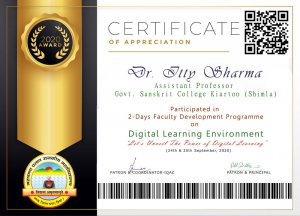 Participant Detail Dr. Itty Sharma Assistant Professor Govt. Sanskrit College Kiartoo Shimla Session Details Participant present in all the sessions on 24th & 25th September, 2020. Barcode ID Itty SharmaMPGCAMBfdp2020p15
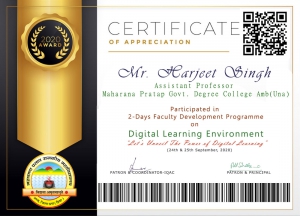 Participant Detail
Mr. Harjeet Singh
Assistant Professor
Maharana Pratap Govt. Degree College Amb (Una)
Session Details
Participant present in all the sessions on 24th & 25th September, 2020.
Barcode ID
Mr. Harjeet SinghMPGCAMBfdp2020p16
Participant Detail
Mr. Harjeet Singh
Assistant Professor
Maharana Pratap Govt. Degree College Amb (Una)
Session Details
Participant present in all the sessions on 24th & 25th September, 2020.
Barcode ID
Mr. Harjeet SinghMPGCAMBfdp2020p16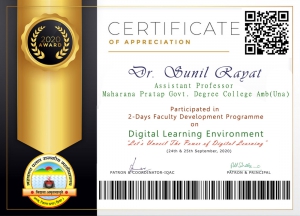 Participant Detail
Dr. Sunil Rayat
Assistant Professor
Maharana Pratap Govt. Degree College Amb (Una)
Session Details
Participant present in all the sessions on 24th & 25th September, 2020.
Barcode ID
Dr. Sunil RayatMPGCAMBfdp2020p17
Participant Detail
Dr. Sunil Rayat
Assistant Professor
Maharana Pratap Govt. Degree College Amb (Una)
Session Details
Participant present in all the sessions on 24th & 25th September, 2020.
Barcode ID
Dr. Sunil RayatMPGCAMBfdp2020p17
 Participant Detail
Mr. Vijainder Singh
Assistant Professor
Maharana Pratap Govt. Degree College Amb (Una)
Session Details
Participant present in all the sessions on 24th & 25th September, 2020.
Barcode ID
Mr. Vijainder SinghMPGCAMBfdp2020p18
Participant Detail
Mr. Vijainder Singh
Assistant Professor
Maharana Pratap Govt. Degree College Amb (Una)
Session Details
Participant present in all the sessions on 24th & 25th September, 2020.
Barcode ID
Mr. Vijainder SinghMPGCAMBfdp2020p18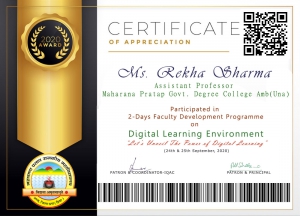 Participant Detail Ms. Rekha Sharma Assistant Professor Maharana Pratap Govt. Degree College Amb (Una) Session Details Participant present in all the sessions on 24th & 25th September, 2020. Barcode ID Ms. Rekha SharmaMPGCAMBfdp2020p19
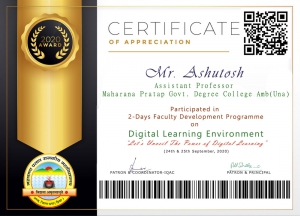 Participant Detail Mr. Ashutosh Assistant Professor Maharana Pratap Govt. Degree College Amb (Una) Session Details Participant present in all the sessions on 24th & 25th September, 2020. Barcode ID Mr. AshutoshMPGCAMBfdp2020p20
 Participant Detail Dr. Godawari Assistant Professor Maharana Pratap Govt. Degree College Amb (Una) Session Details Participant present in all the sessions on 24th & 25th September, 2020. Barcode ID Dr. GodawariMPGCAMBfdp2020p21
 Participant Detail Dr. Kumari Sujata Assistant Professor Maharana Pratap Govt. Degree College Amb (Una) Session Details Participant present in all the sessions on 24th & 25th September, 2020. Barcode ID Dr. Kumari SujataMPGCAMBfdp2020p22
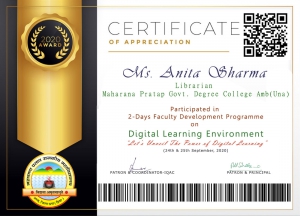 Participant Detail
Ms. Anita Sharma
Librarian
Maharana Pratap Govt. Degree College Amb (Una)
Session Details
Participant present in all the sessions on 24th & 25th September, 2020.
Barcode ID
Ms. Anita SharmaMPGCAMBfdp2020p23
Participant Detail
Ms. Anita Sharma
Librarian
Maharana Pratap Govt. Degree College Amb (Una)
Session Details
Participant present in all the sessions on 24th & 25th September, 2020.
Barcode ID
Ms. Anita SharmaMPGCAMBfdp2020p23 Participant Detail
Dr. Richu Kalia
Assistant Professor
Maharana Pratap Govt. Degree College Amb (Una)
Session Details
Participant present in all the sessions on 24th & 25th September, 2020.
Barcode ID
Dr. Richu KaliaMPGCAMBfdp2020p24
Participant Detail
Dr. Richu Kalia
Assistant Professor
Maharana Pratap Govt. Degree College Amb (Una)
Session Details
Participant present in all the sessions on 24th & 25th September, 2020.
Barcode ID
Dr. Richu KaliaMPGCAMBfdp2020p24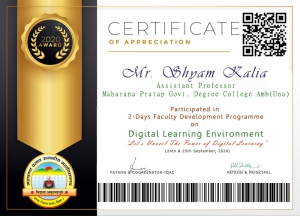 Participant Detail Mr. Shyam Kalia Assistant Professor Maharana Pratap Govt. Degree College Amb (Una) Session Details Participant present in all the sessions on 24th & 25th September, 2020. Barcode ID Mr. Shyam KaliaMPGCAMBfdp2020p25
 Participant Detail Mr. Jag Mohan Assistant Professor Maharana Pratap Govt. Degree College Amb (Una) Session Details Participant present in all the sessions on 24th & 25th September, 2020. Barcode ID Mr. Jag MohanMPGCAMBfdp2020p26
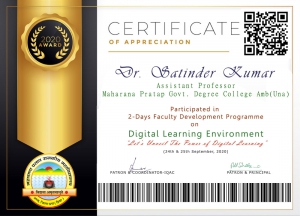 Participant Detail
Dr. Satinder Kumar
Assistant Professor
Maharana Pratap Govt. Degree College Amb (Una)
Session Details
Participant present in all the sessions on 24th & 25th September, 2020.
Barcode ID
Dr. Satinder KumarMPGCAMBfdp2020p27
Participant Detail
Dr. Satinder Kumar
Assistant Professor
Maharana Pratap Govt. Degree College Amb (Una)
Session Details
Participant present in all the sessions on 24th & 25th September, 2020.
Barcode ID
Dr. Satinder KumarMPGCAMBfdp2020p27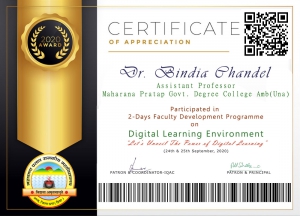 Participant Detail Dr. Bindia Chandel Assistant Professor Maharana Pratap Govt. Degree College Amb (Una) Session Details Participant present in all the sessions on 24th & 25th September, 2020. Barcode ID Dr. Bindia ChandelMPGCAMBfdp2020p28
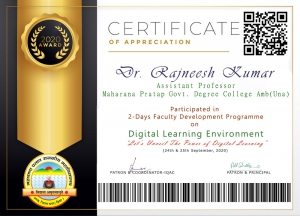 Participant Detail Dr. Rajneesh Kumar Assistant Professor Maharana Pratap Govt. Degree College Amb (Una) Session Details Participant present in all the sessions on 24th & 25th September, 2020. Barcode ID Dr. Rajneesh KumarMPGCAMBfdp2020p29
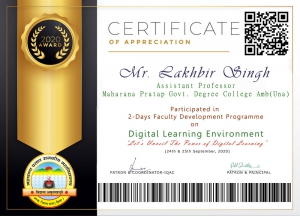 Participant Detail
Mr. Lakhbir Singh
Assistant Professor
Maharana Pratap Govt. Degree College Amb (Una)
Session Details
Participant present in all the sessions on 24th & 25th September, 2020.
Barcode ID
Mr. Lakhbir SinghMPGCAMBfdp2020p30
Participant Detail
Mr. Lakhbir Singh
Assistant Professor
Maharana Pratap Govt. Degree College Amb (Una)
Session Details
Participant present in all the sessions on 24th & 25th September, 2020.
Barcode ID
Mr. Lakhbir SinghMPGCAMBfdp2020p30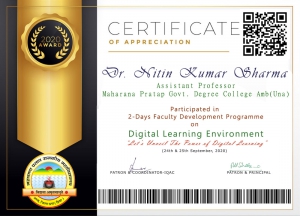 Participant Detail
Dr. Nitin Kumar Sharma
Assistant Professor
Maharana Pratap Govt. Degree College Amb (Una)
Session Details
Participant present in all the sessions on 24th & 25th September, 2020.
Barcode ID
Dr. Nitin Kumar SharmaMPGCAMBfdp2020p31
Participant Detail
Dr. Nitin Kumar Sharma
Assistant Professor
Maharana Pratap Govt. Degree College Amb (Una)
Session Details
Participant present in all the sessions on 24th & 25th September, 2020.
Barcode ID
Dr. Nitin Kumar SharmaMPGCAMBfdp2020p31
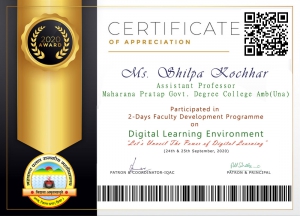 Participant Detail
Ms. Shilpa Kochhar
Assistant Professor
Maharana Pratap Govt. Degree College Amb (Una)
Session Details
Participant present in all the sessions on 24th & 25th September, 2020.
Barcode ID
Ms. Shilpa KochharMPGCAMBfdp2020p32
Participant Detail
Ms. Shilpa Kochhar
Assistant Professor
Maharana Pratap Govt. Degree College Amb (Una)
Session Details
Participant present in all the sessions on 24th & 25th September, 2020.
Barcode ID
Ms. Shilpa KochharMPGCAMBfdp2020p32 Participant Detail Ms. Preeti Assistant Professor Maharana Pratap Govt. Degree College Amb (Una) Session Details Participant present in all the sessions on 24th & 25th September, 2020. Barcode ID Ms. PreetiMPGCAMBfdp2020p33
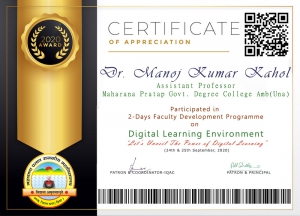 Participant Detail Dr. Manoj Kumar Kahol Assistant Professor Maharana Pratap Govt. Degree College Amb (Una) Session Details Participant present in all the sessions on 24th & 25th September, 2020. Barcode ID Dr. Manoj Kumar KaholMPGCAMBfdp2020p36
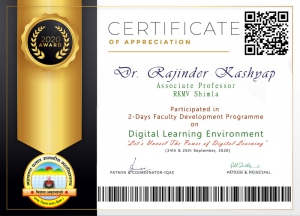 Participant Detail
Dr. Rajinder Kashyap
Associate Professor
RKMV Shimla
Session Details
Participant present in all the sessions on 24th & 25th September, 2020.
Barcode ID
Dr. Rajinder KashyapMPGCAMBfdp2020p37
Participant Detail
Dr. Rajinder Kashyap
Associate Professor
RKMV Shimla
Session Details
Participant present in all the sessions on 24th & 25th September, 2020.
Barcode ID
Dr. Rajinder KashyapMPGCAMBfdp2020p37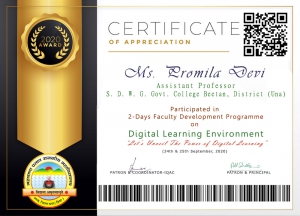 Participant Detail
Ms. Promila Devi
Assistant Professor
S. D. W. G. Govt. College Beetan, District Una(H.P)
Session Details
Participant present in all the sessions on 24th & 25th September, 2020.
Barcode ID
Ms. Promila DeviMPGCAMBfdp2020p39
Participant Detail
Ms. Promila Devi
Assistant Professor
S. D. W. G. Govt. College Beetan, District Una(H.P)
Session Details
Participant present in all the sessions on 24th & 25th September, 2020.
Barcode ID
Ms. Promila DeviMPGCAMBfdp2020p39 Participant Detail Ms. Richa Sharma Assistant Professor S. D. W. G. Govt. College Beetan, District Una(H.P) Session Details Participant present in all the sessions on 24th & 25th September, 2020. Barcode ID Ms. Richa SharmaMPGCAMBfdp2020p38
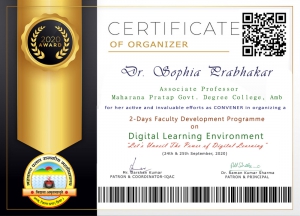 Organizer's Detail Dr. Sophia Prabhakar Associate Professor Maharana Pratap Govt. Degree College, Amb Session Details Organizer present in all the sessions on 24th & 25th September, 2020. Barcode ID Dr. Sophia Prabhakar\MPGCAMB\FDP2020O03
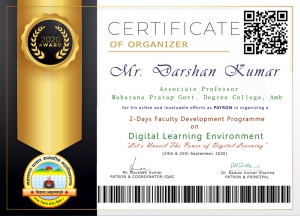 Organizer's Detail Mr. Darshan Kumar Associate Professor Maharana Pratap Govt. Degree College, Amb FDP-Patron Session Details Organizer present in all the sessions on 24th & 25th September, 2020. Barcode ID Mr. Darshan Kumar\MPGCAMB\FDP2020O02
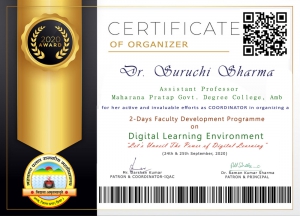 Organizer's Detail Dr. Suruchi Sharma Assistant Professor Maharana Pratap Govt. Degree College, Amb FDP-Coordinator Session Details Organizer present in all the sessions on 24th & 25th September, 2020. Barcode ID Dr. Suruchi Sharma\MPGCAMB\FDP2020O05
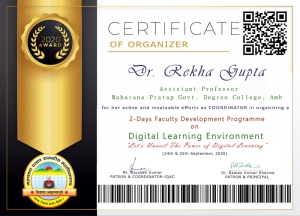 Participant Detail Ms. Richa Sharma Assistant Professor S. D. W. G. Govt. College Beetan, District Una(H.P) Session Details Participant present in all the sessions on 24th & 25th September, 2020. Barcode ID Ms. Richa SharmaMPGCAMBfdp2020p38
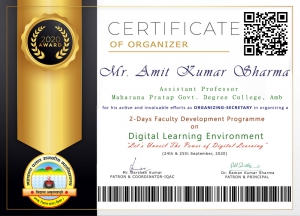 Organizer's Detail Mr. Amit Kumar Sharma Assistant Professor Maharana Pratap Govt. Degree College, Amb FDP-Organizing Secretary Session Details Organizer present in all the sessions on 24th & 25th September, 2020. Barcode ID Mr. Amit Kumar Sharma\MPGCAMB\FDP2020O07
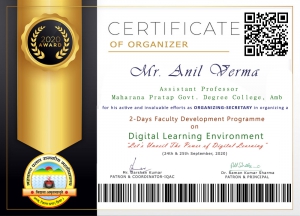 Organizer's Detail Mr. Anil Verma Assistant Professor Maharana Pratap Govt. Degree College, Amb FDP-Organizing Secretary Session Details Organizer present in all the sessions on 24th & 25th September, 2020. Barcode ID Mr. Anil Verma\MPGCAMB\FDP2020O08
Leave a Reply
Want to join the discussion?Feel free to contribute!