
Vibrant_promotions_and_spin-king-casino_uk_deliver_captivating_gaming_experience
- Vibrant promotions and spin-king-casino.uk deliver captivating gaming experiences today
- The Evolution of Digital Entertainment Systems
- Advanced Software Architectures
- Diversification of Gaming Content and Themes
- The Role of Narrative in Gameplay
- Strategic Approaches to User Engagement
- Implementing Effective Reward Systems
- Technical Reliability and Platform Stability
- Optimizing the User Interface for Maximum Flow
- Future Trends in Digital Gaming Ecosystems
Vibrant promotions and spin-king-casino.uk deliver captivating gaming experiences today
The digital landscape of online gaming has undergone a massive transformation over the last decade, moving from simple pixelated interfaces to complex, immersive environments. Modern players seek more than just basic mechanics; they crave high-fidelity graphics, seamless transitions, and a sense of genuine excitement that keeps them engaged for longer sessions. When exploring the latest developments in this sector, platforms such as spin-king-casino.uk stand out due to their ability to balance technical stability with a wide variety of interactive content. This evolution is driven by a constant demand for novelty and better user experiences, forcing developers to innovate at an unprecedented pace to satisfy a global audience of enthusiasts.
Understanding the mechanics behind successful gaming hubs requires a deep dive into how software developers integrate psychological triggers with mathematical fairness. It is not merely about the visual appeal but also about the underlying algorithms that ensure every spin or hand is handled with integrity. As competition grows, the distinction between mediocre platforms and industry leaders becomes clearer through their commitment to security and variety. The current market trends suggest that users are increasingly prioritizing mobile compatibility and rapid transaction processing, making these features essential components for any serious operator looking to maintain a competitive edge in a crowded digital marketplace.
The Evolution of Digital Entertainment Systems
The journey of digital entertainment began with rudimentary arcade-style logic, where the primary goal was to provide quick bursts of dopamine through simple win-loss cycles. As computing power increased, these systems transitioned into the sophisticated online environments we recognize today. Modern engines allow for complex animations and real-time interactions that mimic the physical sensation of playing in a traditional setting. This technological leap has been crucial in maintaining user interest, as it bridges the gap between the tactile world and the digital realm, creating a hybrid experience that is both convenient and visually stunning.
One of the most significant changes in this sector involves the integration of high-speed data processing, which allows for live-streamed content and instant results. This immediacy is vital for modern users who expect zero latency during their gaming sessions. When a platform manages to deliver a lag-free environment, it builds a level of trust that is difficult to achieve otherwise. The technical backbone of these services often relies on distributed cloud architecture, ensuring that players from different geographical locations experience the same level of responsiveness and fairness, regardless of their local infrastructure limitations.
Advanced Software Architectures
Software developers now utilize advanced frameworks to create modular gaming environments where new features can be added without disrupting the existing ecosystem. This modularity is key to longevity, as it allows a platform to evolve alongside changing player preferences. By isolating different functions, such as the payment gateway, the game engine, and the user interface, engineers can optimize each component specifically for its intended task. This specialization results in a more robust system that can handle massive influxes of concurrent users during peak hours without experiencing significant downtime or performance degradation.
Furthermore, the use of sophisticated encryption protocols has become a standard requirement for maintaining the privacy and security of user data. In an era where cyber threats are increasingly common, the ability to protect financial transactions and personal identities is the foundation of any reputable gaming service. Developers spend countless hours testing their systems against potential vulnerabilities, implementing multi-layered security defenses that go far beyond basic password protection. This proactive approach to security is what allows users to focus entirely on their entertainment rather than worrying about the safety of their digital footprint.
| Graphics Quality | 2D Sprites and Static Backgrounds | 3D Rendering and Dynamic Lighting |
| User Interface | Fixed Menu Navigation | Adaptive and Gesture-Based Design |
| Security Layer | Basic SSL Encryption | Multi-Factor Authentication & Biometrics |
| Game Engine | Single-Threaded Logic | Multi-Core Parallel Processing |
As seen in the comparison above, the gap between standard and advanced systems is widening. The industry is moving toward a future where artificial intelligence might even play a role in personalizing the user interface and suggesting content based on individual playstyles. This level of customization would represent the pinnacle of the user experience, making every session feel unique and tailored to the specific interests of the player, thereby increasing the overall value proposition of the digital entertainment ecosystem.
Diversification of Gaming Content and Themes
Variety is the lifeblood of any successful gaming platform, and the ability to offer a diverse range of themes is what keeps a user base from becoming stagnant. In the early days, most games shared very similar aesthetic qualities, often focusing on generic symbols or simple geometric shapes. Today, we see a massive expansion into themed content that borrows heavily from mythology, cinema, history, and pop culture. This thematic depth allows players to immerse themselves in different worlds, whether they are exploring ancient temples or navigating futuristic space landscapes, which significantly enhances the emotional connection to the gameplay.
This diversification is not just skin-deep; it involves complex mathematical models that are tailored to fit the specific theme of the game. For example, a high-volatility game set in a high-stakes heist theme might offer massive, infrequent rewards to simulate the tension of a robbery. Conversely, a more casual, fruit-themed game might focus on frequent, smaller wins to provide a more relaxed experience. This strategic alignment between mathematical volatility and thematic storytelling is a hallmark of high-quality game design, ensuring that the mechanical experience complements the visual and narrative elements perfectly.
The Role of Narrative in Gameplay
Narrative elements have become increasingly important as players demand more depth from their digital interactions. Instead of just clicking a button and waiting for a result, many modern users enjoy following a storyline where their actions or the progression of their play might trigger new narrative beats. This sense of progression creates a goal-oriented environment that encourages long-term engagement. When a game tells a story, it transforms from a simple gambling tool into a piece of interactive media, which can attract a much broader demographic of players who value content quality.
To implement this effectively, developers must work closely with writers and storyboard artists to ensure that the game mechanics do not clash with the story being told. A well-integrated narrative can turn a repetitive cycle into an epic journey, where each win or loss feels like a chapter in a larger saga. While this requires more resources and development time, the payoff in terms of user retention and brand loyalty is immense. It is this commitment to storytelling that separates the transient hits from the enduring classics in the digital gaming sphere.
- Thematic consistency across all visual and audio elements.
- Integration of character progression and unlockable content.
- Dynamic soundtracks that react to the intensity of the gameplay.
- Complex bonus rounds that expand upon the core narrative.
By employing these strategies, operators can create a rich tapestry of content that caters to every possible preference. The goal is to ensure that no matter what a player is looking for, they can find a specialized experience that resonates with them. This constant rotation of new themes and mechanics is essential for preventing boredom and maintaining the vibrancy of the platform, ensuring that the ecosystem remains as fresh and exciting as it was on day one.
Strategic Approaches to User Engagement
Maintaining a high level of engagement requires a multifaceted approach that combines psychological insights with data-driven decision-making. It is not enough to simply provide games; an operator must also create an environment that feels rewarding and interactive. This is often achieved through loyalty programs, tiered membership structures, and periodic events that reward consistent participation. These systems are designed to recognize the value of a dedicated user base, providing incentives that encourage players to return to the platform regularly.
Data analytics plays a crucial role in these engagement strategies. By studying player behavior, developers can identify patterns that indicate when a user might be losing interest or when a particular type of game is gaining popularity. This information allows for real-time adjustments to the platform, such as the introduction of targeted promotions or the highlighting of new content that matches a user's previous preferences. This level of precision in marketing and engagement is what allows modern platforms to achieve such high levels of customer satisfaction and lifetime value.
Implementing Effective Reward Systems
A successful reward system must be perceived as fair and attainable. If the requirements to reach a new tier or claim a prize are too high, users will quickly become disillusioned and abandon the platform. Therefore, the progression must feel steady and rewarding at every stage. This often involves a mix of instant gratifications, such as small bonuses, and long-term goals, such as exclusive access to new features or premium content. Balancing these two types of rewards is a delicate art that requires constant monitoring and adjustment based on actual user feedback and behavior.
- Analyze current player demographics and their preferred gaming styles.
- Design a multi-tiered loyalty program with clearly defined milestones.
- Integrate automated notification systems to alert users of upcoming rewards.
- Monitor the impact of each reward tier on long-term retention rates.
Furthermore, the integration of social elements can significantly boost engagement. Features that allow players to compete on leaderboards or participate in community-driven challenges add a layer of social validation that is extremely powerful. When players feel like they are part of a larger community, they are much more likely to remain loyal to the platform. This shift from solitary play to social interaction is one of the most significant trends in the industry, reflecting the broader move toward social gaming across all digital media platforms.
Technical Reliability and Platform Stability
At the heart of any successful gaming enterprise is the underlying technical infrastructure. Even the most visually stunning and content-rich platform will fail if it cannot provide a stable and reliable connection for its users. Server uptime, low latency, and rapid response times are the non-negotiable pillars of a professional service. For a brand like spin-king-casino.uk, maintaining this stability is a continuous process of monitoring, testing, and upgrading hardware and software. Any significant outage or period of instability can lead to a massive loss of user trust and a corresponding drop in revenue.
Achieving this level of reliability requires a proactive approach to server management. This includes the use of load balancers to distribute traffic evenly across multiple servers and the implementation of failover systems that can automatically take over if a primary server fails. Additionally, regular maintenance windows must be scheduled during periods of low activity to ensure that the system remains optimized without causing unnecessary disruption to the user base. The goal is to create an environment that feels permanent and dependable, a digital space where players can reliably spend their time and resources.
Security is another critical aspect of technical reliability. A platform must be able to withstand various forms of cyberattacks, from distributed denial-of-service (DDoS) attacks to more targeted attempts at data theft. This requires a robust security posture that includes real-time threat detection and automated response mechanisms. By investing heavily in cybersecurity, operators not only protect their own assets but also provide the peace of mind that users need to engage fully with the platform. In the digital age, security is not just a feature; it is a fundamental requirement for existence in the gaming industry.
Beyond immediate security and stability, there is also the matter of cross-platform compatibility. As users increasingly move between mobile devices, tablets, and desktop computers, the ability of a platform to provide a consistent experience across all these devices is paramount. This requires the use of responsive design principles and highly optimized mobile applications. A user who starts a session on their phone and later continues it on their laptop should experience no loss in quality or functionality. This seamless transition is a key component of a modern, high-end gaming experience.
Optimizing the User Interface for Maximum Flow
The user interface (UI) is the primary touchpoint between the player and the digital environment. A well-designed UI facilitates a state of flow, where the player becomes so immersed in the gameplay that they lose track of time and external distractions. This is achieved through intuitive navigation, clear visual hierarchies, and minimal clutter. If a user has to struggle to find a specific game or navigate through complex menus to reach their account settings, the sense of immersion is immediately broken. Therefore, every element of the interface must be placed with purpose and precision.
Color theory and typography also play a vital role in shaping the user experience. Different colors can evoke different emotions; for instance, vibrant reds and golds might be used to signify high-stakes excitement, while cooler blues and greens might be used for more relaxed, casual gaming areas. Typography must be legible across all devices and screen sizes, ensuring that instructions, terms, and game details are easily understood. When these aesthetic choices are made with an understanding of human psychology, they work together to create an atmosphere that is both inviting and functionally efficient.
Accessibility is another crucial consideration in modern UI design. As the gaming audience grows to include more diverse groups of people, platforms must ensure that their interfaces are usable by individuals with different levels of visual, auditory, or motor abilities. This includes implementing features like high-contrast modes, adjustable text sizes, and screen reader compatibility. By making the platform accessible to everyone, operators not only expand their potential market but also demonstrate a commitment to inclusivity that can enhance their brand reputation. A truly great interface is one that serves all users effectively, regardless of their physical circumstances.
The iterative process of design and testing is what ultimately leads to a superior user interface. Designers use heatmaps, click-tracking, and user testing sessions to identify friction points within the interface. Once these points are identified, they are addressed through rapid prototyping and refinement. This constant cycle of improvement ensures that the UI stays ahead of user expectations and remains optimized for the latest technological trends. In a field where user attention is the most valuable currency, the ability to provide a frictionless, beautiful, and accessible interface is a significant competitive advantage.
Future Trends in Digital Gaming Ecosystems
Looking toward the horizon, several emerging technologies are poised to redefine the gaming landscape. Virtual reality (VR) and augmented reality (AR) are already beginning to offer more profound levels of immersion, moving beyond the screen and into a three-dimensional space. While these technologies currently require specialized hardware, their increasing accessibility suggests a future where players can inhabit their favorite game worlds in a way that feels truly physical. This shift will likely demand entirely new approaches to game design, focusing on spatial awareness and three-dimensional interaction rather than traditional two-dimensional inputs.
Another significant trend is the deepening integration of blockchain technology and decentralized finance. This could lead to more transparent and provably fair gaming environments, where every outcome is recorded on an immutable ledger. Furthermore, the rise of digital assets and true ownership of in-game items could create entirely new economies within gaming platforms. Players might not just consume content but could also participate in the creation and trading of digital goods, adding a layer of economic complexity and player agency that has never been seen before. This evolution toward a decentralized model could fundamentally change the relationship between operators and users, fostering a more collaborative and participatory ecosystem.
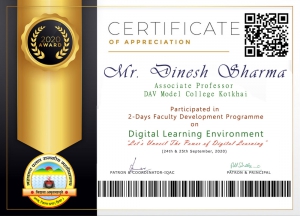 Participant Detail Mr. Dinesh Sharma Associate Professor DAV Model College Kotkhai Session Details Participant present in all the sessions on 24th & 25th September, 2020. Barcode ID Mr. Dinesh SharmaMPGCAMBfdp2020p01
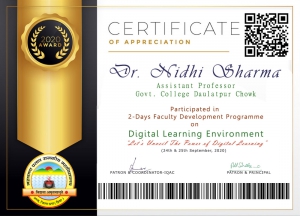 Participant Detail Dr. Nidhi Sharma Assistant Professor Govt. College Daulatpur Chowk Session Details Participant present in all the sessions on 24th & 25th September, 2020. Barcode ID Dr. Nidhi SharmaMPGCAMBfdp2020p02
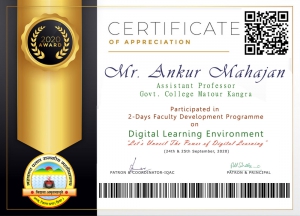 Participant Detail Mr. Ankur Mahajan Assistant Professor Govt. College Matour Kangra Session Details Participant present in all the sessions on 24th & 25th September, 2020. Barcode ID Mr. Ankur MahajannMPGCAMBnfdp2020p03
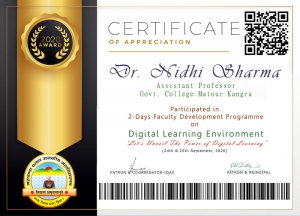 Participant Detail Dr. Nidhi Sharma Assistant Professor Govt. College Matour Kangra Session Details Participant present in all the sessions on 24th & 25th September, 2020. Barcode ID Dr. Nidhi SharmaMPGCAMBfdp2020p04
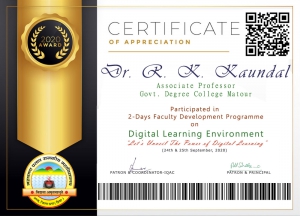 Participant Detail Dr. R. K. Kaundal Associate Professor Govt. Degree College Matour Session Details Participant present in all the sessions on 24th & 25th September, 2020. Barcode ID Dr. R. K. KaundalMPGCAMBfdp2020p05
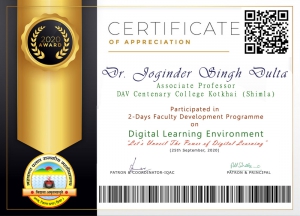 Participant Detail Dr. Joginder Singh Dulta Associate Professor DAV Centenary College Kotkhai (Shimla) Session Details Participant present in last 2 sessions on 25th September, 2020. Barcode ID Dr. Joginder Singh DultaMPGCAMBfdp2020p06
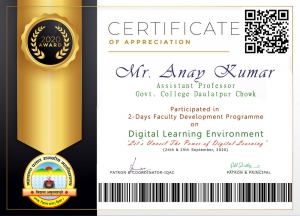 Participant Detail Dr. Nidhi Sharma Assistant Professor Govt. College Matour Kangra Session Details Participant present in all the sessions on 24th & 25th September, 2020. Barcode ID Dr. Nidhi SharmaMPGCAMBfdp2020p04
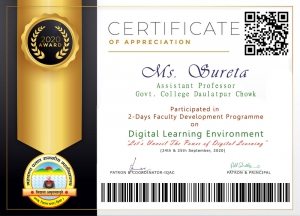 Participant Detail Dr. Nidhi Sharma Assistant Professor Govt. College Matour Kangra Session Details Participant present in all the sessions on 24th & 25th September, 2020. Barcode ID Dr. Nidhi SharmaMPGCAMBfdp2020p04
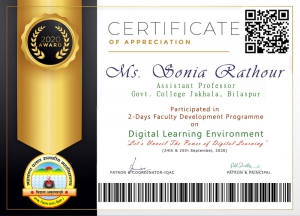 Participant Detail Ms. Sonia Rathour Assistant Professor Govt. College Jukhala, Bilaspur Session Details Participant present in all the sessions on 24th & 25th September, 2020. Barcode ID Ms. Sonia RathourMPGCAMBfdp2020p10
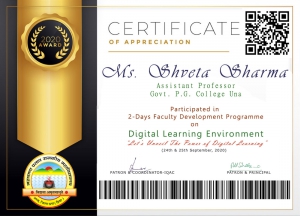 Participant Detail Ms. Shveta Sharma Assistant Professor Govt. P.G. College Una Session Details Participant present in all the sessions on 24th & 25th September, 2020. Barcode ID Ms. Shveta SharmaMPGCAMBfdp2020p11
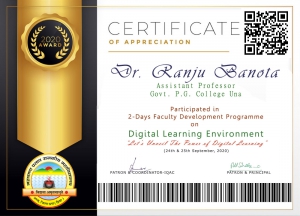 Participant Detail Dr. Ranju Banota Assistant Professor Govt. P.G. College Una Session Details Participant present in all the sessions on 24th & 25th September, 2020. Barcode ID Dr. Ranju BanotaMPGCAMBfdp2020p12
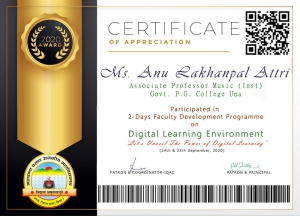 Participant Detail Ms. Anu Lakhanpal Attri Associate Professor Music (Inst) Govt. P.G. College Una Session Details Participant present in all the sessions on 24th & 25th September, 2020. Barcode ID Ms. Anu Lakhanpal AttriMPGCAMBfdp2020p13
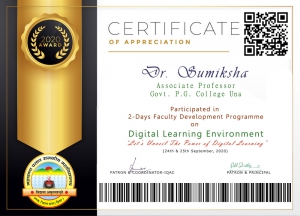 Dr. Sumiksha Associate Professor Govt. P.G. College Una
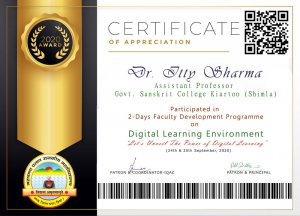 Participant Detail Dr. Itty Sharma Assistant Professor Govt. Sanskrit College Kiartoo Shimla Session Details Participant present in all the sessions on 24th & 25th September, 2020. Barcode ID Itty SharmaMPGCAMBfdp2020p15
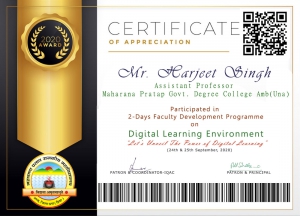 Participant Detail
Mr. Harjeet Singh
Assistant Professor
Maharana Pratap Govt. Degree College Amb (Una)
Session Details
Participant present in all the sessions on 24th & 25th September, 2020.
Barcode ID
Mr. Harjeet SinghMPGCAMBfdp2020p16
Participant Detail
Mr. Harjeet Singh
Assistant Professor
Maharana Pratap Govt. Degree College Amb (Una)
Session Details
Participant present in all the sessions on 24th & 25th September, 2020.
Barcode ID
Mr. Harjeet SinghMPGCAMBfdp2020p16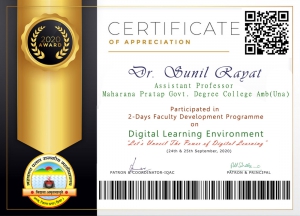 Participant Detail
Dr. Sunil Rayat
Assistant Professor
Maharana Pratap Govt. Degree College Amb (Una)
Session Details
Participant present in all the sessions on 24th & 25th September, 2020.
Barcode ID
Dr. Sunil RayatMPGCAMBfdp2020p17
Participant Detail
Dr. Sunil Rayat
Assistant Professor
Maharana Pratap Govt. Degree College Amb (Una)
Session Details
Participant present in all the sessions on 24th & 25th September, 2020.
Barcode ID
Dr. Sunil RayatMPGCAMBfdp2020p17
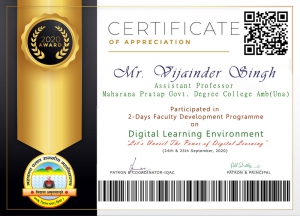 Participant Detail
Mr. Vijainder Singh
Assistant Professor
Maharana Pratap Govt. Degree College Amb (Una)
Session Details
Participant present in all the sessions on 24th & 25th September, 2020.
Barcode ID
Mr. Vijainder SinghMPGCAMBfdp2020p18
Participant Detail
Mr. Vijainder Singh
Assistant Professor
Maharana Pratap Govt. Degree College Amb (Una)
Session Details
Participant present in all the sessions on 24th & 25th September, 2020.
Barcode ID
Mr. Vijainder SinghMPGCAMBfdp2020p18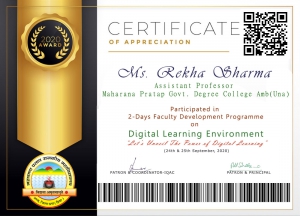 Participant Detail Ms. Rekha Sharma Assistant Professor Maharana Pratap Govt. Degree College Amb (Una) Session Details Participant present in all the sessions on 24th & 25th September, 2020. Barcode ID Ms. Rekha SharmaMPGCAMBfdp2020p19
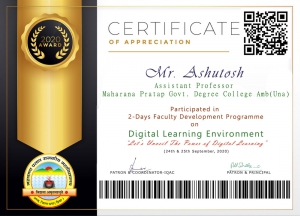 Participant Detail Mr. Ashutosh Assistant Professor Maharana Pratap Govt. Degree College Amb (Una) Session Details Participant present in all the sessions on 24th & 25th September, 2020. Barcode ID Mr. AshutoshMPGCAMBfdp2020p20
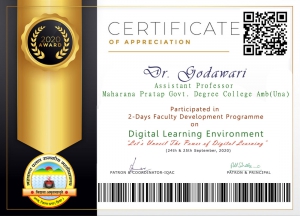 Participant Detail Dr. Godawari Assistant Professor Maharana Pratap Govt. Degree College Amb (Una) Session Details Participant present in all the sessions on 24th & 25th September, 2020. Barcode ID Dr. GodawariMPGCAMBfdp2020p21
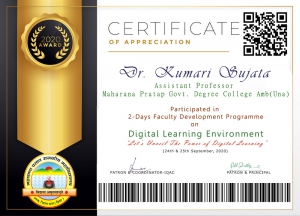 Participant Detail Dr. Kumari Sujata Assistant Professor Maharana Pratap Govt. Degree College Amb (Una) Session Details Participant present in all the sessions on 24th & 25th September, 2020. Barcode ID Dr. Kumari SujataMPGCAMBfdp2020p22
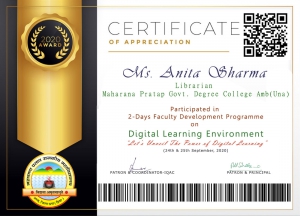 Participant Detail
Ms. Anita Sharma
Librarian
Maharana Pratap Govt. Degree College Amb (Una)
Session Details
Participant present in all the sessions on 24th & 25th September, 2020.
Barcode ID
Ms. Anita SharmaMPGCAMBfdp2020p23
Participant Detail
Ms. Anita Sharma
Librarian
Maharana Pratap Govt. Degree College Amb (Una)
Session Details
Participant present in all the sessions on 24th & 25th September, 2020.
Barcode ID
Ms. Anita SharmaMPGCAMBfdp2020p23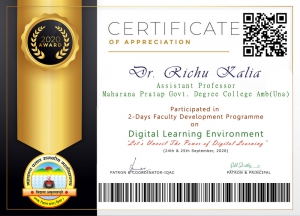 Participant Detail
Dr. Richu Kalia
Assistant Professor
Maharana Pratap Govt. Degree College Amb (Una)
Session Details
Participant present in all the sessions on 24th & 25th September, 2020.
Barcode ID
Dr. Richu KaliaMPGCAMBfdp2020p24
Participant Detail
Dr. Richu Kalia
Assistant Professor
Maharana Pratap Govt. Degree College Amb (Una)
Session Details
Participant present in all the sessions on 24th & 25th September, 2020.
Barcode ID
Dr. Richu KaliaMPGCAMBfdp2020p24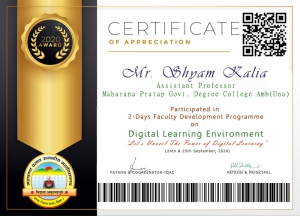 Participant Detail Mr. Shyam Kalia Assistant Professor Maharana Pratap Govt. Degree College Amb (Una) Session Details Participant present in all the sessions on 24th & 25th September, 2020. Barcode ID Mr. Shyam KaliaMPGCAMBfdp2020p25
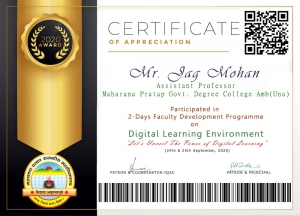 Participant Detail Mr. Jag Mohan Assistant Professor Maharana Pratap Govt. Degree College Amb (Una) Session Details Participant present in all the sessions on 24th & 25th September, 2020. Barcode ID Mr. Jag MohanMPGCAMBfdp2020p26
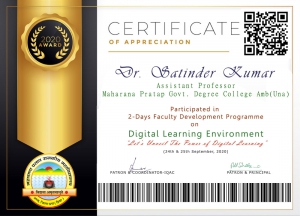 Participant Detail
Dr. Satinder Kumar
Assistant Professor
Maharana Pratap Govt. Degree College Amb (Una)
Session Details
Participant present in all the sessions on 24th & 25th September, 2020.
Barcode ID
Dr. Satinder KumarMPGCAMBfdp2020p27
Participant Detail
Dr. Satinder Kumar
Assistant Professor
Maharana Pratap Govt. Degree College Amb (Una)
Session Details
Participant present in all the sessions on 24th & 25th September, 2020.
Barcode ID
Dr. Satinder KumarMPGCAMBfdp2020p27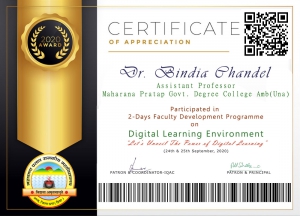 Participant Detail Dr. Bindia Chandel Assistant Professor Maharana Pratap Govt. Degree College Amb (Una) Session Details Participant present in all the sessions on 24th & 25th September, 2020. Barcode ID Dr. Bindia ChandelMPGCAMBfdp2020p28
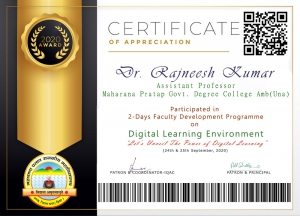 Participant Detail Dr. Rajneesh Kumar Assistant Professor Maharana Pratap Govt. Degree College Amb (Una) Session Details Participant present in all the sessions on 24th & 25th September, 2020. Barcode ID Dr. Rajneesh KumarMPGCAMBfdp2020p29
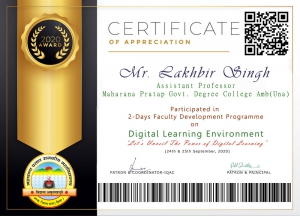 Participant Detail
Mr. Lakhbir Singh
Assistant Professor
Maharana Pratap Govt. Degree College Amb (Una)
Session Details
Participant present in all the sessions on 24th & 25th September, 2020.
Barcode ID
Mr. Lakhbir SinghMPGCAMBfdp2020p30
Participant Detail
Mr. Lakhbir Singh
Assistant Professor
Maharana Pratap Govt. Degree College Amb (Una)
Session Details
Participant present in all the sessions on 24th & 25th September, 2020.
Barcode ID
Mr. Lakhbir SinghMPGCAMBfdp2020p30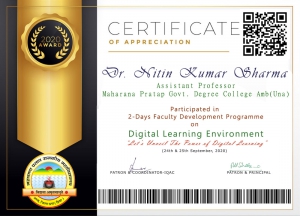 Participant Detail
Dr. Nitin Kumar Sharma
Assistant Professor
Maharana Pratap Govt. Degree College Amb (Una)
Session Details
Participant present in all the sessions on 24th & 25th September, 2020.
Barcode ID
Dr. Nitin Kumar SharmaMPGCAMBfdp2020p31
Participant Detail
Dr. Nitin Kumar Sharma
Assistant Professor
Maharana Pratap Govt. Degree College Amb (Una)
Session Details
Participant present in all the sessions on 24th & 25th September, 2020.
Barcode ID
Dr. Nitin Kumar SharmaMPGCAMBfdp2020p31
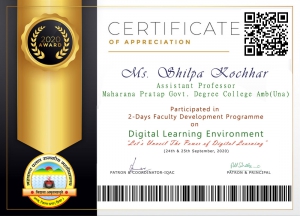 Participant Detail
Ms. Shilpa Kochhar
Assistant Professor
Maharana Pratap Govt. Degree College Amb (Una)
Session Details
Participant present in all the sessions on 24th & 25th September, 2020.
Barcode ID
Ms. Shilpa KochharMPGCAMBfdp2020p32
Participant Detail
Ms. Shilpa Kochhar
Assistant Professor
Maharana Pratap Govt. Degree College Amb (Una)
Session Details
Participant present in all the sessions on 24th & 25th September, 2020.
Barcode ID
Ms. Shilpa KochharMPGCAMBfdp2020p32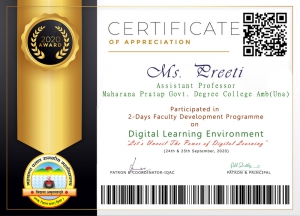 Participant Detail Ms. Preeti Assistant Professor Maharana Pratap Govt. Degree College Amb (Una) Session Details Participant present in all the sessions on 24th & 25th September, 2020. Barcode ID Ms. PreetiMPGCAMBfdp2020p33
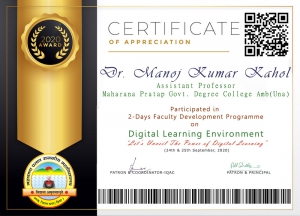 Participant Detail Dr. Manoj Kumar Kahol Assistant Professor Maharana Pratap Govt. Degree College Amb (Una) Session Details Participant present in all the sessions on 24th & 25th September, 2020. Barcode ID Dr. Manoj Kumar KaholMPGCAMBfdp2020p36
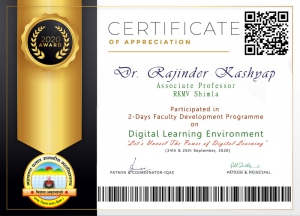 Participant Detail
Dr. Rajinder Kashyap
Associate Professor
RKMV Shimla
Session Details
Participant present in all the sessions on 24th & 25th September, 2020.
Barcode ID
Dr. Rajinder KashyapMPGCAMBfdp2020p37
Participant Detail
Dr. Rajinder Kashyap
Associate Professor
RKMV Shimla
Session Details
Participant present in all the sessions on 24th & 25th September, 2020.
Barcode ID
Dr. Rajinder KashyapMPGCAMBfdp2020p37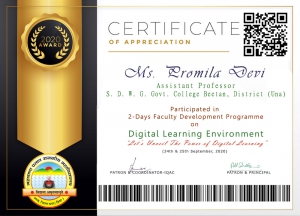 Participant Detail
Ms. Promila Devi
Assistant Professor
S. D. W. G. Govt. College Beetan, District Una(H.P)
Session Details
Participant present in all the sessions on 24th & 25th September, 2020.
Barcode ID
Ms. Promila DeviMPGCAMBfdp2020p39
Participant Detail
Ms. Promila Devi
Assistant Professor
S. D. W. G. Govt. College Beetan, District Una(H.P)
Session Details
Participant present in all the sessions on 24th & 25th September, 2020.
Barcode ID
Ms. Promila DeviMPGCAMBfdp2020p39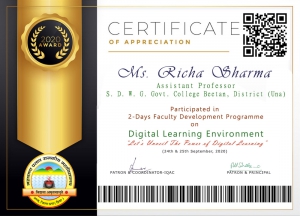 Participant Detail Ms. Richa Sharma Assistant Professor S. D. W. G. Govt. College Beetan, District Una(H.P) Session Details Participant present in all the sessions on 24th & 25th September, 2020. Barcode ID Ms. Richa SharmaMPGCAMBfdp2020p38
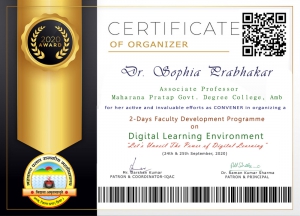 Organizer's Detail Dr. Sophia Prabhakar Associate Professor Maharana Pratap Govt. Degree College, Amb Session Details Organizer present in all the sessions on 24th & 25th September, 2020. Barcode ID Dr. Sophia Prabhakar\MPGCAMB\FDP2020O03
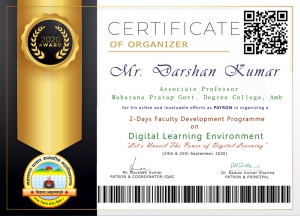 Organizer's Detail Mr. Darshan Kumar Associate Professor Maharana Pratap Govt. Degree College, Amb FDP-Patron Session Details Organizer present in all the sessions on 24th & 25th September, 2020. Barcode ID Mr. Darshan Kumar\MPGCAMB\FDP2020O02
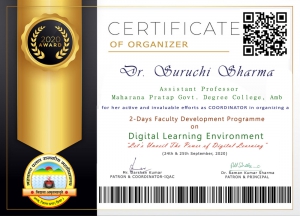 Organizer's Detail Dr. Suruchi Sharma Assistant Professor Maharana Pratap Govt. Degree College, Amb FDP-Coordinator Session Details Organizer present in all the sessions on 24th & 25th September, 2020. Barcode ID Dr. Suruchi Sharma\MPGCAMB\FDP2020O05
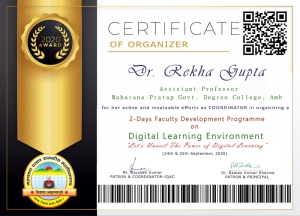 Participant Detail Ms. Richa Sharma Assistant Professor S. D. W. G. Govt. College Beetan, District Una(H.P) Session Details Participant present in all the sessions on 24th & 25th September, 2020. Barcode ID Ms. Richa SharmaMPGCAMBfdp2020p38
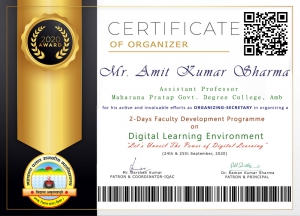 Organizer's Detail Mr. Amit Kumar Sharma Assistant Professor Maharana Pratap Govt. Degree College, Amb FDP-Organizing Secretary Session Details Organizer present in all the sessions on 24th & 25th September, 2020. Barcode ID Mr. Amit Kumar Sharma\MPGCAMB\FDP2020O07
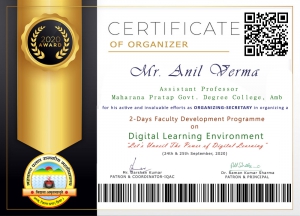 Organizer's Detail Mr. Anil Verma Assistant Professor Maharana Pratap Govt. Degree College, Amb FDP-Organizing Secretary Session Details Organizer present in all the sessions on 24th & 25th September, 2020. Barcode ID Mr. Anil Verma\MPGCAMB\FDP2020O08
Leave a Reply
Want to join the discussion?Feel free to contribute!