
Volatility_defines_the_thrill_of_crash_casino_games_and_potential_payouts
- Volatility defines the thrill of crash casino games and potential payouts
- Understanding the Mechanics of Crash Games
- The Role of Provably Fair Technology
- Strategies for Playing Crash Games
- Bankroll Management Techniques
- The Evolution of Crash Game Features
- The Psychological Appeal of Crash Games
- Future Trends in Crash Game Development
Volatility defines the thrill of crash casino games and potential payouts
The digital landscape of gambling has undergone a significant transformation in recent years, with a surge in innovative casino game formats designed to captivate a new generation of players. Among these, crash casino games have rapidly gained prominence, distinguished by their simple yet intensely thrilling mechanics and potential for substantial rewards. These games offer a unique blend of risk and reward, requiring players to cash out before a randomly determined ‘crash’ occurs, multiplying their bet in the process.
The appeal of these games lies in their accessibility and fast-paced nature. Unlike traditional casino games that may require strategic complexity or extensive knowledge, crash games are easy to understand and play, making them attractive to both seasoned gamblers and newcomers alike. This ease of use, combined with the excitement of unpredictable outcomes, has fueled their increasing popularity across online casinos worldwide. From desktop computers to mobile devices, anyone with an internet connection can experience the adrenaline rush of trying to beat the crash.
Understanding the Mechanics of Crash Games
At their core, crash games are exceptionally straightforward. A multiplier begins increasing from 1x, and players place bets hoping to cash out before the multiplier ‘crashes’ – meaning it stops increasing and any remaining bets are lost. The longer you wait to cash out, the higher the multiplier, and thus the larger your potential payout. However, this inherently involves increased risk. The timing of the crash is entirely random, adding an element of suspense and unpredictability to each round. Most platforms also offer features like ‘auto cash out’ that allow players to pre-set a multiplier at which their bet will automatically be cashed out, minimizing the risk of missing out on potential winnings.
The random number generator (RNG) is the heart of any legitimate crash game. A robust and provably fair RNG ensures that the crash point is truly random, offering players assurance that the game isn’t rigged. Reputable online casinos frequently subject their RNGs to independent audits by third-party testing agencies to verify their fairness and transparency. Players can frequently examine the seed and hash values used by the RNG, further bolstering confidence in the game’s integrity.
The Role of Provably Fair Technology
Provably fair technology has become a cornerstone of trust in the online gambling industry, and it’s particularly critical for crash games. This system allows players to verify the randomness of each game outcome, ensuring that the casino cannot manipulate the results. Typically, it involves the use of cryptographic algorithms and server seeds that are published before each round. Players can then use this information, alongside their client seeds, to independently verify the fairness of the game's outcome. This transparency builds trust and encourages responsible gambling.
Beyond simply proving fairness, the visibility of these systems discourages any attempts at manipulation. Casinos understand that any evidence of unfairness will quickly erode player trust and damage their reputation. Consequently, investing in robust provably fair technology is a fundamental aspect of operating a legitimate crash game platform.
| 1.1x – 1.5x | Low | Low |
| 1.6x – 2.0x | Moderate | Moderate |
| 2.1x – 3.0x | High | High |
| 3.1x + | Very High | Very High |
As the table illustrates, the potential payout directly correlates with the risk involved. Successfully cashing out at higher multipliers yields significantly larger returns, but also requires a greater degree of courage and a touch of luck. Players often develop different strategies based on their risk tolerance and desired level of payout.
Strategies for Playing Crash Games
While crash games are fundamentally based on chance, several strategies can be employed to manage risk and potentially increase your winnings. One common approach is the ‘Martingale’ strategy, which involves doubling your bet after each loss, with the idea that eventually, a win will recover all previous losses and provide a profit. However, this strategy requires a substantial bankroll and carries a high risk of significant losses. Another strategy is to set a target multiplier and automatically cash out whenever that multiplier is reached, providing a consistent and predictable return. Some players also prefer to utilize a combination of these approaches, adapting their strategy based on the game’s volatility and their personal risk appetite.
It's crucial to understand that no strategy can guarantee a win in a crash game. The inherent randomness of the crash point makes it impossible to predict the outcome with certainty. Successful crash game players often prioritize bankroll management, setting strict limits on how much they are willing to bet and avoiding chasing losses. Responsible gambling practices are paramount, ensuring that the game remains a source of entertainment rather than a financial burden.
Bankroll Management Techniques
Effective bankroll management is perhaps the most important skill for any crash game player. This involves setting a budget for your gambling activities and sticking to it, regardless of wins or losses. A simple rule of thumb is to only bet a small percentage of your bankroll on each round – typically between 1% and 5%. This helps to minimize the risk of quickly depleting your funds. Setting loss limits is equally important; determine the maximum amount you are willing to lose in a single session and stop playing once you reach that limit. Similarly, setting win goals can help you lock in profits and avoid giving back your winnings.
Diversifying your bets across multiple rounds can also be a prudent strategy. Instead of placing a large bet on a single round, spreading your bankroll across several smaller bets reduces the impact of any single crash. Remember, the goal isn’t necessarily to win big on every round, but to consistently accumulate small profits over time. Patience and discipline are key to successful bankroll management in crash games.
The Evolution of Crash Game Features
The basic premise of crash games has remained consistent, but developers have continuously introduced innovative features to enhance the player experience. Some platforms offer ‘social’ features, allowing players to chat with each other and share their strategies. Others incorporate ‘live’ crash games hosted by real dealers, adding a social and interactive element to the gameplay. Increasingly, we're seeing the integration of bonus rounds and challenges that provide additional opportunities to win, and further enrich the core game mechanic.
Another emerging trend is the integration of cryptocurrency payments. Many online casinos now accept Bitcoin, Ethereum, and other cryptocurrencies, offering players faster and more secure transactions. This is particularly appealing to players who value privacy and anonymity. The growing demand for mobile gaming has also led to the development of fully optimized crash game apps, allowing players to enjoy the excitement of the game on the go.
- Enhanced Social Interaction: Chat features and live dealer options.
- Cryptocurrency Integration: Faster, secure, and private transactions.
- Mobile Optimization: Seamless gameplay on smartphones and tablets.
- Bonus Rounds and Challenges: Additional opportunities to win.
- Provably Fair Verification: Increased transparency and trust.
These advancements demonstrate the commitment of game developers to constantly improving the crash game experience and attracting a wider audience. By incorporating new technologies and features, they are ensuring that these games remain fresh, engaging, and competitive in the rapidly evolving online gambling landscape.
The Psychological Appeal of Crash Games
The enduring popularity of crash games isn’t solely attributable to their simple mechanics or potential for large payouts. A significant factor is the psychological thrill they provide. The escalating multiplier creates a feeling of anticipation and excitement, while the constant threat of a crash introduces a unique form of tension. This combination of anticipation and anxiety taps into primal human instincts, making the experience highly addictive. The ‘near miss’ – where the multiplier crashes just after a player cashes out – can be particularly frustrating, but also reinforces the desire to try again, hoping for a bigger win next time.
The element of control, albeit limited, also plays a role. Players have the agency to decide when to cash out, giving them a sense of power over their fate. This sense of control can be particularly appealing in a world where many aspects of life feel unpredictable and out of our hands. Furthermore, the visual aesthetics of crash games often contribute to their psychological appeal, with bright colors, dynamic animations, and immersive sound effects creating a stimulating and engaging environment.
- Anticipation and Excitement: The rising multiplier creates a thrill.
- The Thrill of Risk: The impending crash introduces tension.
- Sense of Control: Players decide when to cash out.
- Visual and Auditory Stimulation: Engaging graphics and sounds.
- Psychological Reward System: The potential for large payouts.
Understanding these psychological factors is crucial for both players and game developers. Players can use this knowledge to practice responsible gambling and avoid becoming addicted, while developers can leverage these insights to create even more compelling and engaging game experiences.
Future Trends in Crash Game Development
The future of crash games appears bright, with several exciting trends on the horizon. We can expect to see further integration of virtual reality (VR) and augmented reality (AR) technologies, creating immersive and interactive gaming experiences. Imagine playing a crash game in a virtual casino environment, interacting with other players and a live dealer in real-time. Furthermore, the use of artificial intelligence (AI) is likely to become more prevalent, potentially used to personalize the gaming experience and optimize payout structures. Blockchain technology may also play a larger role, enhancing the security and transparency of crash games through decentralized and immutable ledgers.
The focus on ‘gamification’ – incorporating game-like elements into non-game contexts – is also expected to intensify. This could involve introducing complex achievement systems, leaderboards, and social challenges to further engage players and foster a sense of community. It’s also likely that we’ll see more experimentation with different themes and aesthetics, catering to a wider range of player preferences. The growth of esports and streaming platforms will likely drive the development of spectator-friendly crash game formats, where viewers can watch and interact with players in real-time. The continued innovation in this space points to crash games remaining a dynamic and captivating component of the online casino landscape for years to come.
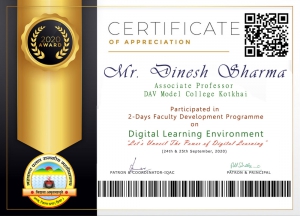 Participant Detail Mr. Dinesh Sharma Associate Professor DAV Model College Kotkhai Session Details Participant present in all the sessions on 24th & 25th September, 2020. Barcode ID Mr. Dinesh SharmaMPGCAMBfdp2020p01
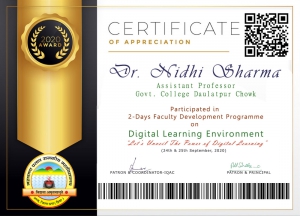 Participant Detail Dr. Nidhi Sharma Assistant Professor Govt. College Daulatpur Chowk Session Details Participant present in all the sessions on 24th & 25th September, 2020. Barcode ID Dr. Nidhi SharmaMPGCAMBfdp2020p02
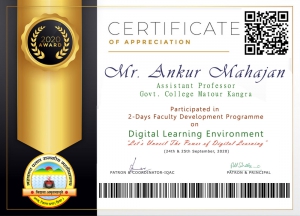 Participant Detail Mr. Ankur Mahajan Assistant Professor Govt. College Matour Kangra Session Details Participant present in all the sessions on 24th & 25th September, 2020. Barcode ID Mr. Ankur MahajannMPGCAMBnfdp2020p03
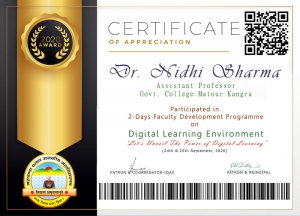 Participant Detail Dr. Nidhi Sharma Assistant Professor Govt. College Matour Kangra Session Details Participant present in all the sessions on 24th & 25th September, 2020. Barcode ID Dr. Nidhi SharmaMPGCAMBfdp2020p04
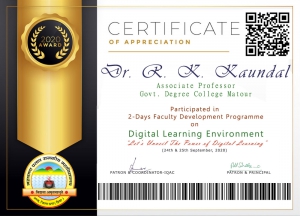 Participant Detail Dr. R. K. Kaundal Associate Professor Govt. Degree College Matour Session Details Participant present in all the sessions on 24th & 25th September, 2020. Barcode ID Dr. R. K. KaundalMPGCAMBfdp2020p05
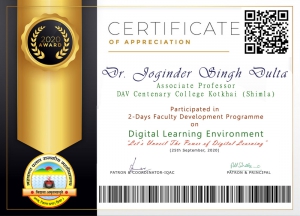 Participant Detail Dr. Joginder Singh Dulta Associate Professor DAV Centenary College Kotkhai (Shimla) Session Details Participant present in last 2 sessions on 25th September, 2020. Barcode ID Dr. Joginder Singh DultaMPGCAMBfdp2020p06
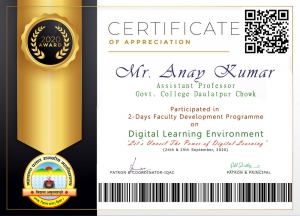 Participant Detail Dr. Nidhi Sharma Assistant Professor Govt. College Matour Kangra Session Details Participant present in all the sessions on 24th & 25th September, 2020. Barcode ID Dr. Nidhi SharmaMPGCAMBfdp2020p04
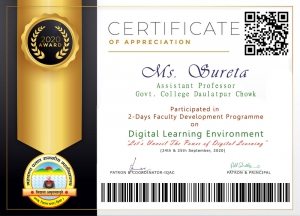 Participant Detail Dr. Nidhi Sharma Assistant Professor Govt. College Matour Kangra Session Details Participant present in all the sessions on 24th & 25th September, 2020. Barcode ID Dr. Nidhi SharmaMPGCAMBfdp2020p04
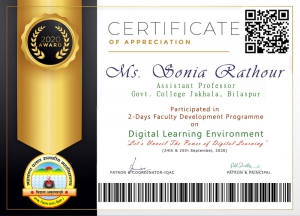 Participant Detail Ms. Sonia Rathour Assistant Professor Govt. College Jukhala, Bilaspur Session Details Participant present in all the sessions on 24th & 25th September, 2020. Barcode ID Ms. Sonia RathourMPGCAMBfdp2020p10
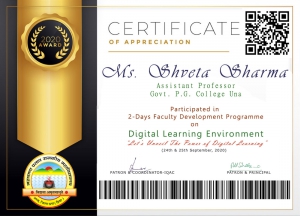 Participant Detail Ms. Shveta Sharma Assistant Professor Govt. P.G. College Una Session Details Participant present in all the sessions on 24th & 25th September, 2020. Barcode ID Ms. Shveta SharmaMPGCAMBfdp2020p11
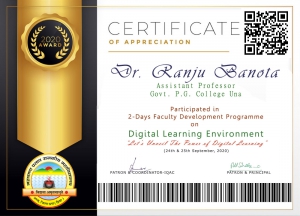 Participant Detail Dr. Ranju Banota Assistant Professor Govt. P.G. College Una Session Details Participant present in all the sessions on 24th & 25th September, 2020. Barcode ID Dr. Ranju BanotaMPGCAMBfdp2020p12
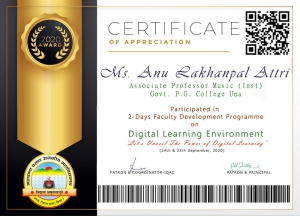 Participant Detail Ms. Anu Lakhanpal Attri Associate Professor Music (Inst) Govt. P.G. College Una Session Details Participant present in all the sessions on 24th & 25th September, 2020. Barcode ID Ms. Anu Lakhanpal AttriMPGCAMBfdp2020p13
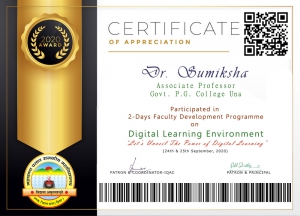 Dr. Sumiksha Associate Professor Govt. P.G. College Una
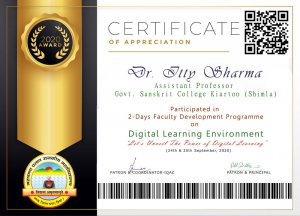 Participant Detail Dr. Itty Sharma Assistant Professor Govt. Sanskrit College Kiartoo Shimla Session Details Participant present in all the sessions on 24th & 25th September, 2020. Barcode ID Itty SharmaMPGCAMBfdp2020p15
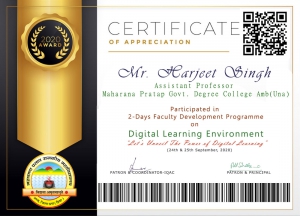 Participant Detail
Mr. Harjeet Singh
Assistant Professor
Maharana Pratap Govt. Degree College Amb (Una)
Session Details
Participant present in all the sessions on 24th & 25th September, 2020.
Barcode ID
Mr. Harjeet SinghMPGCAMBfdp2020p16
Participant Detail
Mr. Harjeet Singh
Assistant Professor
Maharana Pratap Govt. Degree College Amb (Una)
Session Details
Participant present in all the sessions on 24th & 25th September, 2020.
Barcode ID
Mr. Harjeet SinghMPGCAMBfdp2020p16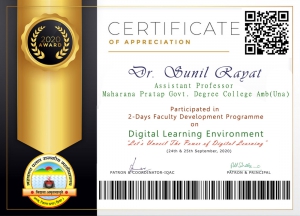 Participant Detail
Dr. Sunil Rayat
Assistant Professor
Maharana Pratap Govt. Degree College Amb (Una)
Session Details
Participant present in all the sessions on 24th & 25th September, 2020.
Barcode ID
Dr. Sunil RayatMPGCAMBfdp2020p17
Participant Detail
Dr. Sunil Rayat
Assistant Professor
Maharana Pratap Govt. Degree College Amb (Una)
Session Details
Participant present in all the sessions on 24th & 25th September, 2020.
Barcode ID
Dr. Sunil RayatMPGCAMBfdp2020p17
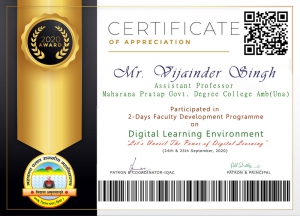 Participant Detail
Mr. Vijainder Singh
Assistant Professor
Maharana Pratap Govt. Degree College Amb (Una)
Session Details
Participant present in all the sessions on 24th & 25th September, 2020.
Barcode ID
Mr. Vijainder SinghMPGCAMBfdp2020p18
Participant Detail
Mr. Vijainder Singh
Assistant Professor
Maharana Pratap Govt. Degree College Amb (Una)
Session Details
Participant present in all the sessions on 24th & 25th September, 2020.
Barcode ID
Mr. Vijainder SinghMPGCAMBfdp2020p18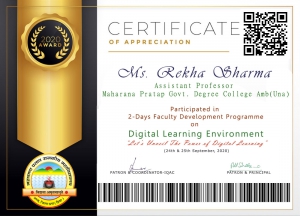 Participant Detail Ms. Rekha Sharma Assistant Professor Maharana Pratap Govt. Degree College Amb (Una) Session Details Participant present in all the sessions on 24th & 25th September, 2020. Barcode ID Ms. Rekha SharmaMPGCAMBfdp2020p19
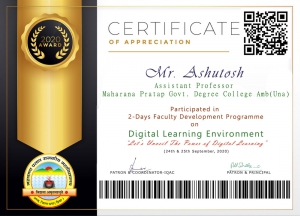 Participant Detail Mr. Ashutosh Assistant Professor Maharana Pratap Govt. Degree College Amb (Una) Session Details Participant present in all the sessions on 24th & 25th September, 2020. Barcode ID Mr. AshutoshMPGCAMBfdp2020p20
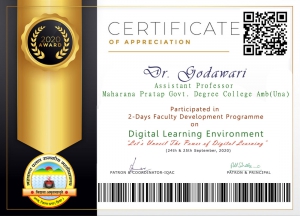 Participant Detail Dr. Godawari Assistant Professor Maharana Pratap Govt. Degree College Amb (Una) Session Details Participant present in all the sessions on 24th & 25th September, 2020. Barcode ID Dr. GodawariMPGCAMBfdp2020p21
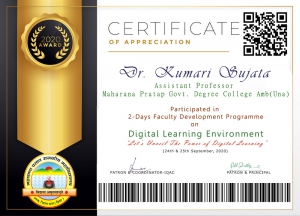 Participant Detail Dr. Kumari Sujata Assistant Professor Maharana Pratap Govt. Degree College Amb (Una) Session Details Participant present in all the sessions on 24th & 25th September, 2020. Barcode ID Dr. Kumari SujataMPGCAMBfdp2020p22
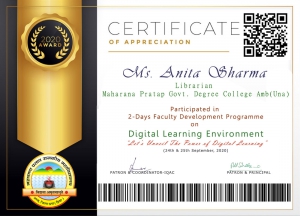 Participant Detail
Ms. Anita Sharma
Librarian
Maharana Pratap Govt. Degree College Amb (Una)
Session Details
Participant present in all the sessions on 24th & 25th September, 2020.
Barcode ID
Ms. Anita SharmaMPGCAMBfdp2020p23
Participant Detail
Ms. Anita Sharma
Librarian
Maharana Pratap Govt. Degree College Amb (Una)
Session Details
Participant present in all the sessions on 24th & 25th September, 2020.
Barcode ID
Ms. Anita SharmaMPGCAMBfdp2020p23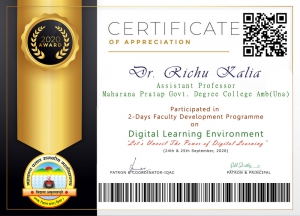 Participant Detail
Dr. Richu Kalia
Assistant Professor
Maharana Pratap Govt. Degree College Amb (Una)
Session Details
Participant present in all the sessions on 24th & 25th September, 2020.
Barcode ID
Dr. Richu KaliaMPGCAMBfdp2020p24
Participant Detail
Dr. Richu Kalia
Assistant Professor
Maharana Pratap Govt. Degree College Amb (Una)
Session Details
Participant present in all the sessions on 24th & 25th September, 2020.
Barcode ID
Dr. Richu KaliaMPGCAMBfdp2020p24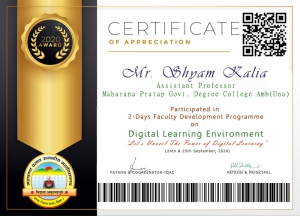 Participant Detail Mr. Shyam Kalia Assistant Professor Maharana Pratap Govt. Degree College Amb (Una) Session Details Participant present in all the sessions on 24th & 25th September, 2020. Barcode ID Mr. Shyam KaliaMPGCAMBfdp2020p25
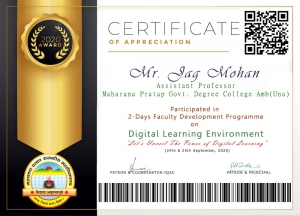 Participant Detail Mr. Jag Mohan Assistant Professor Maharana Pratap Govt. Degree College Amb (Una) Session Details Participant present in all the sessions on 24th & 25th September, 2020. Barcode ID Mr. Jag MohanMPGCAMBfdp2020p26
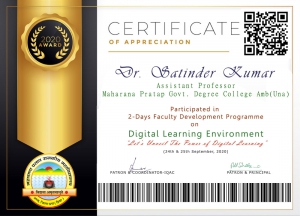 Participant Detail
Dr. Satinder Kumar
Assistant Professor
Maharana Pratap Govt. Degree College Amb (Una)
Session Details
Participant present in all the sessions on 24th & 25th September, 2020.
Barcode ID
Dr. Satinder KumarMPGCAMBfdp2020p27
Participant Detail
Dr. Satinder Kumar
Assistant Professor
Maharana Pratap Govt. Degree College Amb (Una)
Session Details
Participant present in all the sessions on 24th & 25th September, 2020.
Barcode ID
Dr. Satinder KumarMPGCAMBfdp2020p27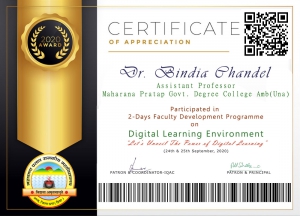 Participant Detail Dr. Bindia Chandel Assistant Professor Maharana Pratap Govt. Degree College Amb (Una) Session Details Participant present in all the sessions on 24th & 25th September, 2020. Barcode ID Dr. Bindia ChandelMPGCAMBfdp2020p28
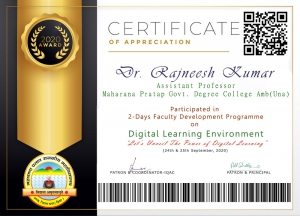 Participant Detail Dr. Rajneesh Kumar Assistant Professor Maharana Pratap Govt. Degree College Amb (Una) Session Details Participant present in all the sessions on 24th & 25th September, 2020. Barcode ID Dr. Rajneesh KumarMPGCAMBfdp2020p29
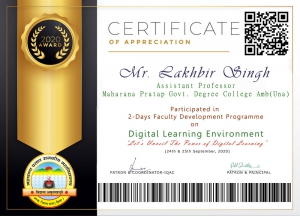 Participant Detail
Mr. Lakhbir Singh
Assistant Professor
Maharana Pratap Govt. Degree College Amb (Una)
Session Details
Participant present in all the sessions on 24th & 25th September, 2020.
Barcode ID
Mr. Lakhbir SinghMPGCAMBfdp2020p30
Participant Detail
Mr. Lakhbir Singh
Assistant Professor
Maharana Pratap Govt. Degree College Amb (Una)
Session Details
Participant present in all the sessions on 24th & 25th September, 2020.
Barcode ID
Mr. Lakhbir SinghMPGCAMBfdp2020p30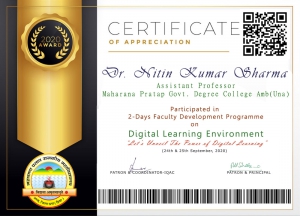 Participant Detail
Dr. Nitin Kumar Sharma
Assistant Professor
Maharana Pratap Govt. Degree College Amb (Una)
Session Details
Participant present in all the sessions on 24th & 25th September, 2020.
Barcode ID
Dr. Nitin Kumar SharmaMPGCAMBfdp2020p31
Participant Detail
Dr. Nitin Kumar Sharma
Assistant Professor
Maharana Pratap Govt. Degree College Amb (Una)
Session Details
Participant present in all the sessions on 24th & 25th September, 2020.
Barcode ID
Dr. Nitin Kumar SharmaMPGCAMBfdp2020p31
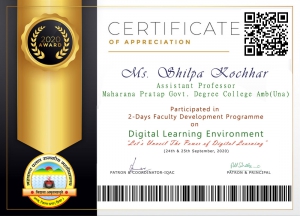 Participant Detail
Ms. Shilpa Kochhar
Assistant Professor
Maharana Pratap Govt. Degree College Amb (Una)
Session Details
Participant present in all the sessions on 24th & 25th September, 2020.
Barcode ID
Ms. Shilpa KochharMPGCAMBfdp2020p32
Participant Detail
Ms. Shilpa Kochhar
Assistant Professor
Maharana Pratap Govt. Degree College Amb (Una)
Session Details
Participant present in all the sessions on 24th & 25th September, 2020.
Barcode ID
Ms. Shilpa KochharMPGCAMBfdp2020p32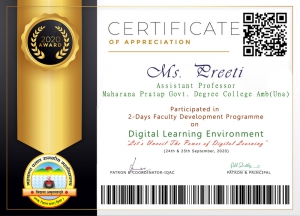 Participant Detail Ms. Preeti Assistant Professor Maharana Pratap Govt. Degree College Amb (Una) Session Details Participant present in all the sessions on 24th & 25th September, 2020. Barcode ID Ms. PreetiMPGCAMBfdp2020p33
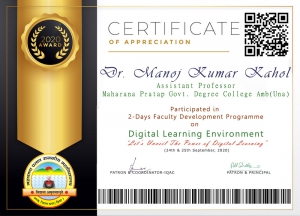 Participant Detail Dr. Manoj Kumar Kahol Assistant Professor Maharana Pratap Govt. Degree College Amb (Una) Session Details Participant present in all the sessions on 24th & 25th September, 2020. Barcode ID Dr. Manoj Kumar KaholMPGCAMBfdp2020p36
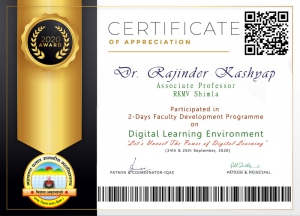 Participant Detail
Dr. Rajinder Kashyap
Associate Professor
RKMV Shimla
Session Details
Participant present in all the sessions on 24th & 25th September, 2020.
Barcode ID
Dr. Rajinder KashyapMPGCAMBfdp2020p37
Participant Detail
Dr. Rajinder Kashyap
Associate Professor
RKMV Shimla
Session Details
Participant present in all the sessions on 24th & 25th September, 2020.
Barcode ID
Dr. Rajinder KashyapMPGCAMBfdp2020p37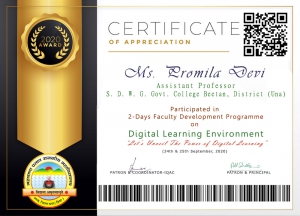 Participant Detail
Ms. Promila Devi
Assistant Professor
S. D. W. G. Govt. College Beetan, District Una(H.P)
Session Details
Participant present in all the sessions on 24th & 25th September, 2020.
Barcode ID
Ms. Promila DeviMPGCAMBfdp2020p39
Participant Detail
Ms. Promila Devi
Assistant Professor
S. D. W. G. Govt. College Beetan, District Una(H.P)
Session Details
Participant present in all the sessions on 24th & 25th September, 2020.
Barcode ID
Ms. Promila DeviMPGCAMBfdp2020p39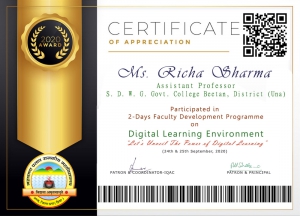 Participant Detail Ms. Richa Sharma Assistant Professor S. D. W. G. Govt. College Beetan, District Una(H.P) Session Details Participant present in all the sessions on 24th & 25th September, 2020. Barcode ID Ms. Richa SharmaMPGCAMBfdp2020p38
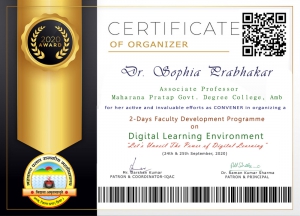 Organizer's Detail Dr. Sophia Prabhakar Associate Professor Maharana Pratap Govt. Degree College, Amb Session Details Organizer present in all the sessions on 24th & 25th September, 2020. Barcode ID Dr. Sophia Prabhakar\MPGCAMB\FDP2020O03
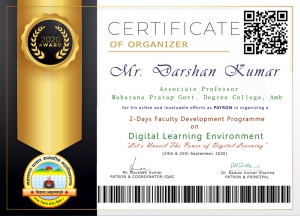 Organizer's Detail Mr. Darshan Kumar Associate Professor Maharana Pratap Govt. Degree College, Amb FDP-Patron Session Details Organizer present in all the sessions on 24th & 25th September, 2020. Barcode ID Mr. Darshan Kumar\MPGCAMB\FDP2020O02
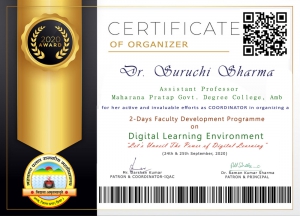 Organizer's Detail Dr. Suruchi Sharma Assistant Professor Maharana Pratap Govt. Degree College, Amb FDP-Coordinator Session Details Organizer present in all the sessions on 24th & 25th September, 2020. Barcode ID Dr. Suruchi Sharma\MPGCAMB\FDP2020O05
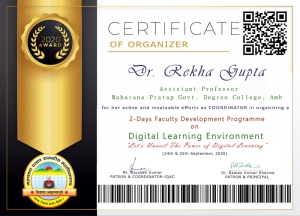 Participant Detail Ms. Richa Sharma Assistant Professor S. D. W. G. Govt. College Beetan, District Una(H.P) Session Details Participant present in all the sessions on 24th & 25th September, 2020. Barcode ID Ms. Richa SharmaMPGCAMBfdp2020p38
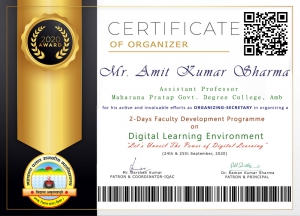 Organizer's Detail Mr. Amit Kumar Sharma Assistant Professor Maharana Pratap Govt. Degree College, Amb FDP-Organizing Secretary Session Details Organizer present in all the sessions on 24th & 25th September, 2020. Barcode ID Mr. Amit Kumar Sharma\MPGCAMB\FDP2020O07
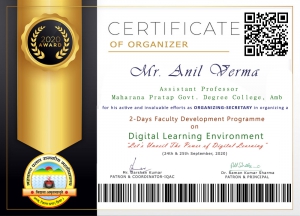 Organizer's Detail Mr. Anil Verma Assistant Professor Maharana Pratap Govt. Degree College, Amb FDP-Organizing Secretary Session Details Organizer present in all the sessions on 24th & 25th September, 2020. Barcode ID Mr. Anil Verma\MPGCAMB\FDP2020O08
Leave a Reply
Want to join the discussion?Feel free to contribute!